

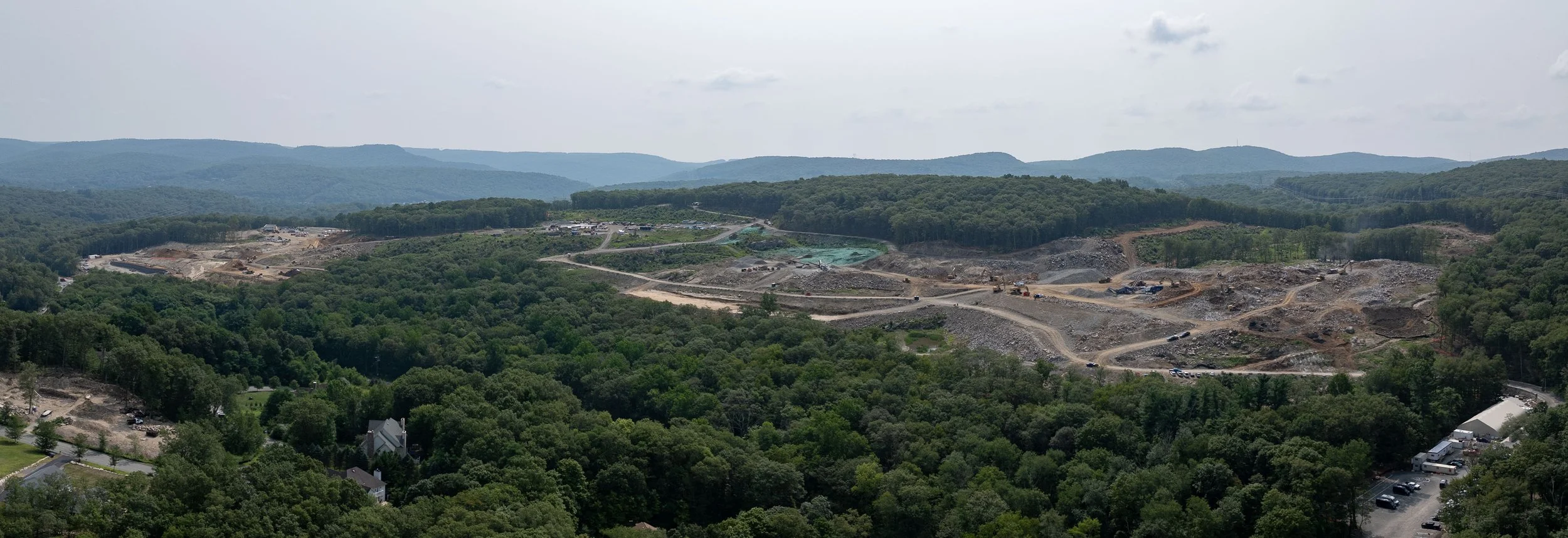
Ringwood and the Highlands Act
THERE IS A BUILDING BOOM IN NEW JERSEY
Ringwood is a haven of natural beauty, protected from sprawl thanks to the New Jersey Highlands Water Protection and Planning Act.
New Jersey is the most densely populated state in the nation. Even so, new warehouses, apartments and mixed used developments are springing up throughout our state. Several major development projects are rapidly reshaping the surrounding area. In Wanaque, developers are constructing a 272,000-square-foot warehouse. In Wayne, a massive 1,369-unit housing complex is rising near Point View Reservoir. Sparta officials are advancing plans for the proposed 880,000-square-foot Diamond Chip mega-warehouse. Just across the border in Sloatsburg, New York, construction continues on the new 250-acre Jehovah’s Witness Video Production Center.
The NJ Highlands Water Protection and Planning Act
The New Jersey Highlands Water Protection and Planning Act(Highlands Act) was signed into law on August 10, 2004 primarily to protect the drinking water source for over 70 percent of the state's residents, curb rapid overdevelopment, and conserve critical environmental resources.
Ringwood was one of 5 towns placed 100% in the Highlands Preservation Area because it serves as a "vast repository of protected watershed lands.” The Wanaque Reservoir, located within Wanaque and Ringwood, provides drinking water for 3 million New Jerseyans. The town contains large, un-fragmented forest blocks and critical wildlife habitats that are essential for maintaining the region's ecological health.
At the time of the Act’s passage, there were significant concerns in Ringwood about rapid development threatening the integrity of these watershed lands. Ridgelines, on both sides of Skyline Drive, were being clear cut. This development was unpopular with Ringwood residents who did not like the changing landscape. When the Highlands Act was passed, the legislation was widely supported in Ringwood as a necessary measure to protect drinking water resources and preserve the environmental character of the Highlands region. Ringwood's Democratic leadership, including then-Mayor Wenke Taule, supported the designation, recognizing the long-term value of protecting the watershed for generations.
As adopted, the Highlands Act established several financial mechanisms to assist municipalities and landowners in the Preservation Area primarily through the Highlands Protection Fund. This funding was gutted by Governor Christie. In the years since, there has been an active campaign to rewrite history and blame the Highlands Act for any problem facing our town, rather than pursuing solutions in line with the town’s environmental character, including pushing to restore State Aid.
Governor Christie and the Gutting of State Aid
Governor Chris Christie’s FY 2011 budget eliminated the municipal compensation for Highlands towns. The budget explicitly stated that “direct aid to certain Highlands communities will no longer be provided.”
While the regulatory structure of the Highlands Act remained fully intact (including development limitations, environmental standards, and preservation requirements) the financial support for towns like Ringwood was gutted.
Ringwood Democrats have always supported fair compensation for our role protecting the drinking water for millions of New Jersey residents. Ringwood Republicans, who have been in power since 2008, only recently began lobbying for Highlands compensation. While this is welcome, it is long overdue. For years they left millions of dollars in State aid and hundreds of thousands in Highlands Council grant funding on the table, largely because of their opposition to the Highlands Act. They used the Act as an excuse for budget mismanagement and blamed Democrats, even though they could have been lobbying for compensation.
Watershed Moratorium Offset Aid and the Highlands Act
The Highlands Act was the result of nearly two decades of efforts to conserve and protect the water resources of northern New Jersey. Its roots go back to 1988, when Republican Governor Tom Kean signed the original watershed moratorium legislation, and the aid program itself was formally codified in 1999 under Republican Governor Christie Whitman. The Highlands Act in 2004 did not create new eligibility criteria or a new list of qualifying towns. It simply redirected an existing funding source. The decisions about which municipalities would qualify were made years before Governor McGreevey or any Democrat had any hand in it.
When the Highlands Task Force was ordered by Governor McGreevey in September 2003, it set in motion a process that moved relatively quickly given the urgency of those water protection concerns. The bulk of the negotiations over how municipalities would be designated and what aid they would receive took place during that period. Any influence a Ringwood mayor may have had over those discussions would have fallen squarely on Republican Mayor Jerry Holt, who held office from 2002 to 2003. By the time the Highlands Act was finalized and signed in August 2004, those decisions had already been made. Wenke Taule served as Mayor of Ringwood in 2004 and 2005, but the window for meaningful local input into the legislation had largely closed before she took office. It is also worth noting that Mayor Taule was elected as a Democrat in a historically Republican town precisely because residents were frustrated with the overdevelopment on steep slopes that was occurring at the time. Her election reflected the community's alignment with the conservation goals the Highlands Act was designed to achieve.
When the New Jersey Highlands Water Protection and Planning Act was signed into law on August 10, 2004, it incorporated the existing watershed moratorium aid program into the newly created Highlands Protection Fund. The six municipalities that received this aid were Vernon Township, Hardyston Township, Rockaway Township, Jefferson Township, Kinnelon Borough, and West Milford Township. Their eligibility was not a political decision made in 2004. It was determined by a straightforward geographic and legal fact: those towns had Newark-owned Pequannock Watershed lands within their borders. That definition had been established in 1988 and carried forward unchanged.
We have always believed that Ringwood should receive aid. The development restrictions it faces are among the most stringent in the region, as the entire borough lies within the Highlands Preservation Area. But Ringwood's omission is not a Democratic failure or a political carve-out. It is the result of a land ownership distinction established decades earlier under Republican leadership, a distinction the Highlands Act inherited rather than created. The case for revisiting Ringwood's eligibility today is a strong one, and it is not helped by mischaracterizing how or why the current framework came to be.
A Major Step Forward: State Aid for Highlands Towns
In 2025, Governor Phil Murphy signed Senate Bill S-3466/A-4627 into law. This legislation marked a major victory for Ringwood and other Highlands communities by ensuring that municipalities protecting vital watershed lands are eligible for state aid from the Highlands Protection Fund.
This was a long-overdue acknowledgment of the role Highlands towns play as environmental stewards, and it reflects years of advocacy by local leaders, including the Ringwood Democratic Organization, which has consistently supported funding solutions tied to the Highlands Act.
Looking Ahead
New Jersey Assembly Bill A3217, introduced January 13, 2026, would secure stable state funding for Highlands communities while upholding the protections of the 2004 Highlands Act.
Help make it happen by telling your State representatives: Senator Pennacchio (joe@senatorjoe.com); Assemblyman Bergen (R), Assemblyman Webber (R) that you support this bill!
Key aspects of Bill A3217
Purpose: Creates a permanent State aid program to compensate “qualified municipalities” for losses in vacant land value caused by development restrictions under the Highlands Water Protection and Planning Act.
Qualified municipalities: Towns entirely within the Highlands preservation area, or towns with a significant portion of their Highlands land in the preservation area, that have conformed to the Highlands regional master plan.
Funding: Aid would come from a new Highlands Preservation Area Municipal Property Tax Relief Fund, funded through the existing Highlands Protection Fund.
Calculation: Aid is calculated based on the decrease in vacant land value from a 2023 base year to the current tax year.
Sponsors: NJ Assembly Republicans Jay Webber, Erik Peterson, Brian Bergen, Aura Dunn, and Dawn Fantasia.
Status: Currently under review by the Assembly Environment and Solid Waste Committee.